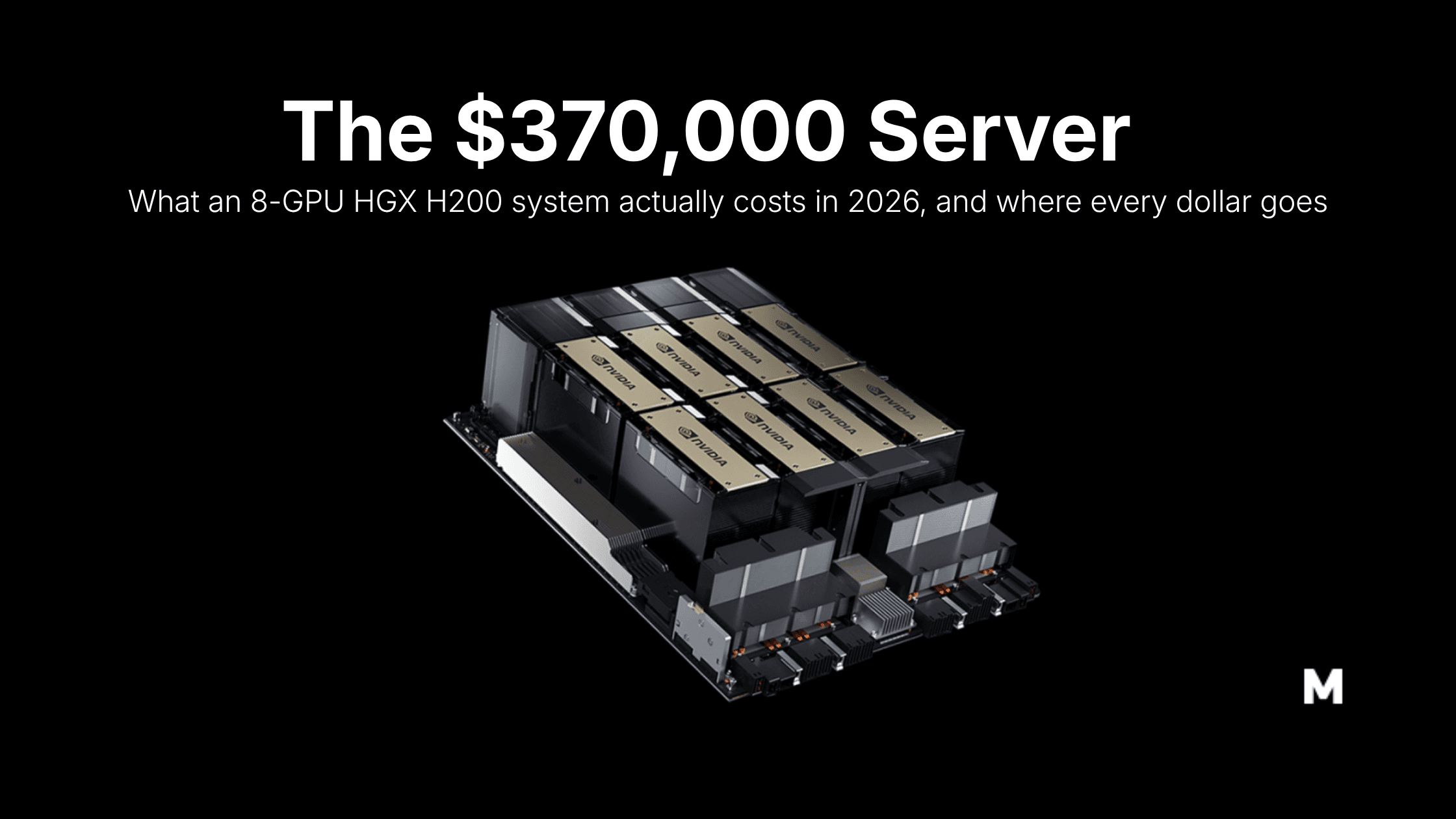
An 8-GPU HGX H200 server costs $320,000 to $420,000 in 2026, with $370,000 as the typical integrated price from major OEMs. That works out to roughly $46,000 per GPU, well above the $32,000 to $40,000 price of a standalone H200 SXM5 card.
The gap is the part most buyers underestimate. The GPUs are only 70 to 78 percent of the system price. The rest is chassis, NVLink fabric, networking, and integration, and it changes the economics of every buy vs rent decision made at the server level.
This guide covers the full system price, what is inside it, how OEM quotes differ, what an owned server actually costs per GPU-hour, and when renting equivalent capacity wins. For per-GPU pricing, see H200 Price. For the comparison framework across generations, see A100 vs H100 vs H200.
How much does an 8x H200 server cost in 2026?
| Configuration | Price (2026) | Per-GPU equivalent |
|---|---|---|
| 8-GPU HGX H200 server, OEM integrated (Supermicro, Dell, HPE) | $320,000 – $420,000 | $40,000 – $52,500 |
| Typical mid-range quote | ~$370,000 | ~$46,000 |
| Standalone H200 SXM5 GPU (for reference) | $32,000 – $40,000 | $32,000 – $40,000 |
The relevant unit for institutional buyers is the integrated system, not the card. H200 SXM5 modules are not practically deployable outside an HGX baseboard, so the server price is the real acquisition price.
Volume changes the number materially. Multi-system orders typically come in 8 to 12 percent below single-system quotes, and buyers acquiring 50 or more systems directly through NVIDIA partners can land 15 to 20 percent below typical OEM list.
What's inside the $370,000?
Where the money goes in a typical integrated 8-GPU HGX H200 system:
| Component | Approximate cost |
|---|---|
| 8x H200 SXM5 GPUs | $256,000 – $320,000 |
| Server hardware (CPUs, memory, motherboard, chassis) | ~$30,000 |
| NVLink fabric / NVSwitch | ~$15,000 |
| Networking and storage | $20,000 – $30,000 |
| Integration, BIOS validation, vendor support | $10,000 – $15,000 |
Two takeaways. First, the non-GPU components add $75,000 to $90,000 on top of the cards, which is why per-GPU cost lands near $46,000 rather than $36,000. Second, any cost model that amortizes only the GPU price understates real ownership cost by roughly 20 percent. The worked example below uses the full system number for exactly that reason.
Whitebox builds can shave the integration and support line items, but most institutional buyers stay with OEM for warranty and support coverage, and finance teams generally prefer a single depreciable asset with vendor backing.
Why do OEM quotes for the same system vary 25 percent?
Same NVIDIA silicon, same HGX baseboard, different list prices. The spread comes from four variables:
- Volume tier. Multi-system orders run 8 to 12 percent below single-system quotes.
- Region. EU and APAC quotes typically land 5 to 10 percent above US pricing on import duties and logistics.
- OEM choice. Supermicro is consistently the low quote. Dell and HPE price their support tiers into the system.
- Service level. Gold-tier support adds 8 to 15 percent over basic coverage.
The practical move: get quotes from at least two OEMs and one specialty integrator before committing. On a $370,000 system, the spread between the high and low quote routinely exceeds the cost of an entire additional GPU.
8x H100 vs 8x H200 server price
| 8x H100 HGX server | 8x H200 HGX server | Premium | |
|---|---|---|---|
| OEM integrated price (typical) | ~$285,000 | ~$370,000 | +30% |
| Per-GPU equivalent | ~$36,000 | ~$46,000 | +28% |
| Memory per system | 640 GB HBM3 | 1,128 GB HBM3e | +76% |
| Memory bandwidth per GPU | 3.35 TB/s | 4.8 TB/s | +43% |
The 30 percent system premium buys 76 percent more memory and 43 percent more bandwidth at identical compute throughput. For long-context inference and large model serving, the premium usually pays for itself in consolidation: fewer H200 systems serve the same memory footprint. For compute-bound training, the H100 system remains the better dollar-per-FLOP buy. The decision framework is in H100 vs H200, and per-GPU H100 pricing is in H100 GPU Cost.
What does an owned H200 server cost per GPU-hour?
Worked example: one 8-GPU HGX H200 server in US Tier-3 colocation, 70 percent utilization, 3-year horizon.
// text
Hardware: $370,000 capex
        − $92,500 estimated 3-year resale value (~25% retained)
        = $277,500 net depreciation
        ÷ (3 years × 8,760 hours × 0.70 utilization)
        = $15.09 / server-hour amortized

Power: 8 × 700W GPU TDP × 1.4 PUE × $0.10/kWh ≈ $0.78 / server-hour

Colocation: $150/kW/month × 8 kW ÷ 730 hrs/month ≈ $1.64 / server-hour

Ops + maintenance: ~$0.80 / server-hour

Total effective cost: ~$18.30 / server-hour ≈ $2.29 / GPU-hour all-in
Note that this lands above the ~$1.88 per GPU-hour figure you get from amortizing a standalone $36,000 card. The difference is the $75,000 to $90,000 of system hardware around the GPUs. System-level math is the correct basis for a purchase decision, and it runs about 20 percent higher than GPU-only math.
The general formula:
// text
Effective $/GPU-hour =
    (System_capex − Resale_value) / (Lifespan_hours × Utilization × 8)
    + Power_$/hr + Colocation_$/hr + Ops_$/hr
Utilization dominates everything else in this formula. At 90 percent utilization the same server runs about $1.85 per GPU-hour. At 40 percent it climbs past $3.60, and renting wins decisively. The full framework is in GPU ROI, and the resale assumption draws on H100 Depreciation.
Buy vs rent: when does a $370,000 server pay off?
Renting the equivalent 8-GPU H200 capacity, using GPU Index pricing tiers:
| Rental path | $/server-hour (8 GPUs) | vs owned at 70% util (~$18.30) |
|---|---|---|
| Hyperscaler on-demand | $36 – $56 | Owning wins by 2–3× |
| Tier-1 specialty on-demand | $28 – $36 | Owning wins clearly |
| Long-tail on-demand | $20 – $28 | Owning wins at high utilization |
| Long-tail reserved, 3-year | $14.40 – $20 | Competitive with owning |
The honest read: ownership is not automatically cheaper. Three-year reserved capacity from aggressive long-tail providers overlaps the owned cost range, without the capex, the colocation contract, or the resale risk. Ownership wins when utilization is sustained above roughly 70 percent, power is cheap, and the team can operate hardware. It also wins on control: data residency, guaranteed availability, and no exposure to provider repricing.
What tips the math in practice is rarely the sticker price. It is the utilization assumption, and secondarily the items covered in Hidden Cloud GPU Costs on the rental side: egress, storage, and idle reserved capacity.
For current rental pricing across providers, Mercatus GPU Index tracks H200 rates daily.
The full provider-by-provider table, with 8-GPU node costs per month, is in GPU rental prices.
What moves H200 server pricing from here?
- Blackwell ramp. B200 supply growth through 2026 pressures H200 system pricing downward. The pattern from prior generations suggests roughly 10 percent annual decline, with Blackwell availability the main accelerant.
- Long-context inference demand. Memory-heavy workloads keep H200 demand firmer than a pure generational-replacement model would predict.
- Secondary market. Refurbished H200 systems barely exist in 2026. As they appear through 2027, expect pressure on new-system pricing at the low end of the range.
Frequently asked questions
How much does an 8x H200 server cost in 2026?
$320,000 to $420,000 for an integrated 8-GPU HGX H200 system from major OEMs, with $370,000 typical. Volume orders run 8 to 20 percent below list.
Why does the server cost more per GPU than buying H200 cards?
The system adds $75,000 to $90,000 of hardware around the GPUs: chassis and CPUs, NVLink fabric, networking, storage, and integration. Per-GPU cost lands near $46,000 integrated versus $32,000 to $40,000 standalone.
Which OEM has the lowest HGX H200 price?
Supermicro consistently quotes lowest. Dell and HPE carry premiums tied to support tiers. The spread across OEM quotes for comparable configurations runs up to 25 percent.
Is an 8x H100 server a better buy?
At roughly $285,000, the H100 system is about 30 percent cheaper and matches H200 compute throughput. It wins on dollar-per-FLOP for training. H200 wins when memory per system is the constraint. See H100 vs H200.
What does an owned H200 server cost to run?
About $18 to $19 per server-hour all-in at 70 percent utilization on a 3-year horizon, or roughly $2.30 per GPU-hour, including depreciation, power, colocation, and ops.
Should I buy a server or rent H200 capacity?
Above roughly 70 percent sustained utilization, ownership beats on-demand rental clearly and edges out reserved capacity. Below that, long-tail reserved pricing at $14 to $20 per server-hour is hard to beat without owning the utilization problem.
How much power does an 8x H200 server need?
GPU load alone is 5.6 kW (8 x 700W TDP). Budget for full-system draw plus cooling overhead when sizing colocation; the worked example above uses 8 kW of billed capacity.
Methodology
OEM system pricing reflects public quotes from Supermicro, Dell, HPE, and specialty integrators. Rental pricing sourced from Mercatus GPU Index, refreshed daily across 22+ providers. Component cost breakdown based on OEM configuration deltas. Resale assumptions derived from Mercatus H100 depreciation tracking. Last verified: 2026-07-08.