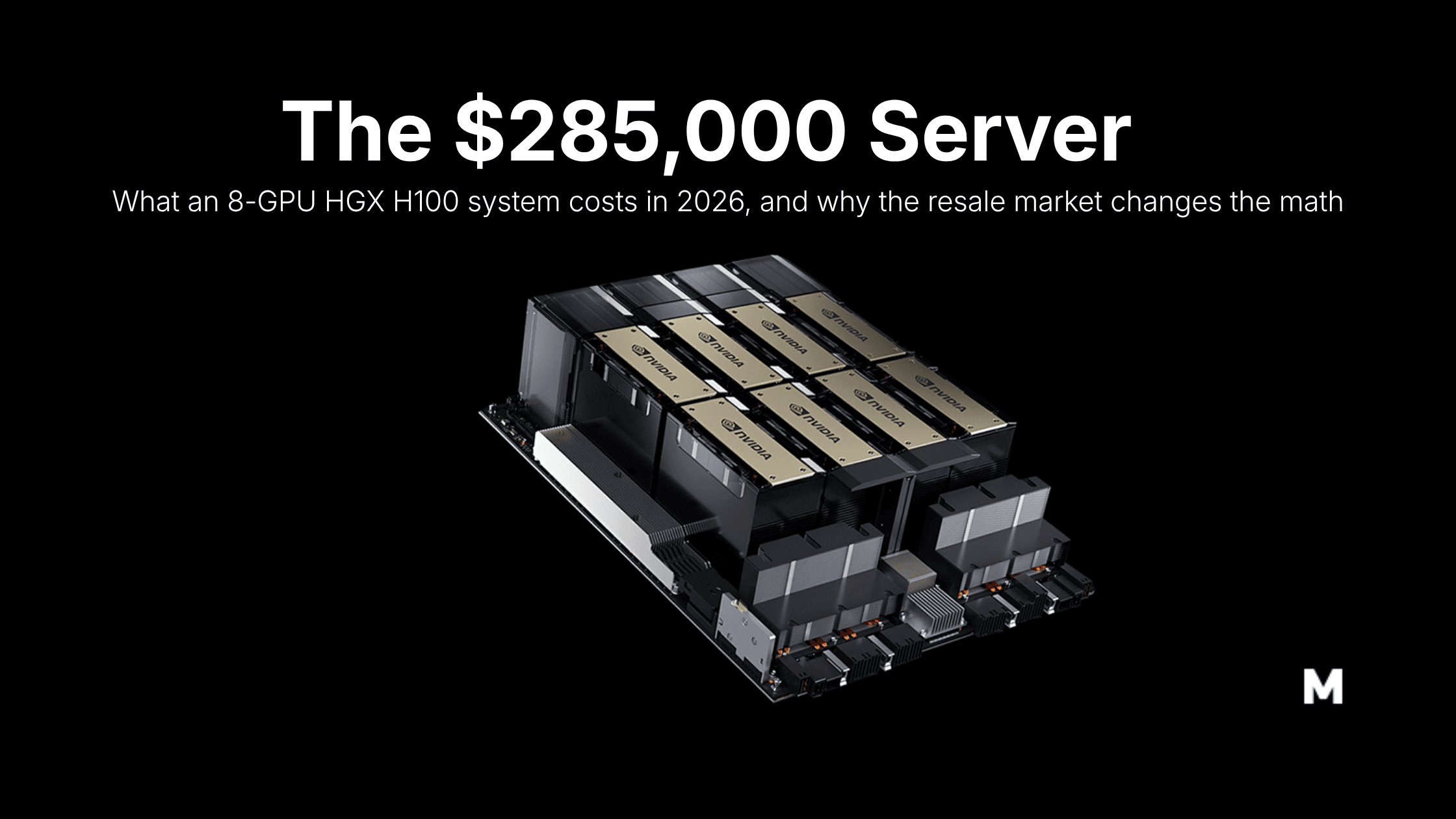
An 8-GPU HGX H100 server costs $250,000 to $320,000 in 2026, with roughly $285,000 as the typical integrated price from major OEMs. That is about $36,000 per GPU deployed, well above the $25,000 to $30,000 list price of a standalone H100 SXM5 card.
The H100 system has one economic property its successor does not: a functioning secondary market. Used H100s trade at predictable prices in 2026, and that resale value moves 3-year ownership cost by up to 30 percent. For a $285,000 purchase decision, the resale assumption matters more than the OEM quote.
This guide covers the system price, what is inside it, what resale does to effective cost, and when renting equivalent capacity wins. For per-GPU pricing, see H100 GPU Cost. For the H200 version of this analysis, see H200 Server Price.
How much does an 8x H100 server cost in 2026?
| Configuration | Price (2026) | Per-GPU equivalent |
|---|---|---|
| 8-GPU HGX H100 server, OEM integrated (Supermicro, Dell, HPE) | $250,000 – $320,000 | $31,000 – $40,000 |
| Typical mid-range quote | ~$285,000 | ~$36,000 |
| Standalone H100 SXM5 GPU (for reference) | $25,000 – $30,000 | $25,000 – $30,000 |
As with the H200, the integrated system is the real acquisition price. H100 SXM5 modules deploy on HGX baseboards in 8-GPU nodes; the standalone card price is a reference point, not a purchasable configuration for production work.
The same quote variables apply across the board: volume orders run 8 to 12 percent below single-system quotes, EU and APAC pricing lands 5 to 10 percent above US, Supermicro consistently quotes lowest, and gold-tier support adds 8 to 15 percent. The full breakdown of why identical hardware prices differently is in Why GPU Prices Differ.
What's inside the $285,000?
| Component | Approximate cost |
|---|---|
| 8x H100 SXM5 GPUs | $200,000 – $240,000 |
| Server hardware (CPUs, memory, motherboard, chassis) | $25,000 – $30,000 |
| NVLink fabric / NVSwitch | ~$15,000 |
| Networking and storage | $20,000 – $30,000 |
| Integration, BIOS validation, vendor support | $10,000 – $15,000 |
The pattern matches the H200 system: $70,000 to $90,000 of hardware wrapped around the GPUs, which is why deployed per-GPU cost runs $6,000 to $10,000 above card list price. Any ownership model that amortizes card price alone understates real cost by roughly 20 percent.
8x H100 vs 8x H200 server price
| 8x H100 HGX server | 8x H200 HGX server | Premium | |
|---|---|---|---|
| OEM integrated price (typical) | ~$285,000 | ~$370,000 | +30% |
| Per-GPU equivalent | ~$36,000 | ~$46,000 | +28% |
| Memory per system | 640 GB HBM3 | 1,128 GB HBM3e | +76% |
| Memory bandwidth per GPU | 3.35 TB/s | 4.8 TB/s | +43% |
| Secondary market in 2026 | Functional, priced | Barely exists |
Compute throughput is identical, so the H100 system remains the better dollar-per-FLOP buy for training. The H200 premium pays for memory, which matters for long-context inference and large model serving. The decision framework is in H100 vs H200.
The last row is the one buyers overlook. An H100 system bought today has an exit price. An H200 system does not yet have a liquid resale market, which makes its depreciation assumption a guess. The H100's is observable.
The H100's hidden advantage: a real secondary market
By 2026 the H100 secondary market is functional. Refurbished cards from data center decommissioning trade at $18,000 to $22,000, and mid-case retained value at 36 months runs 50 to 60 percent of original card price. The full curve is in H100 Depreciation and current street prices are in H100 Resale Value.
For server economics, this changes the single biggest line item. Here is the same 3-year ownership model under three resale scenarios for a $285,000 system (GPU resale only; chassis residual treated as negligible):
| Resale scenario (36 months) | System resale value | Effective cost at 70% utilization |
|---|---|---|
| Conservative (30% card retention) | ~$62,000 | ~$15.30/server-hr (~$1.92/GPU-hr) |
| Mid-case (50–60% retention) | ~$115,000 | ~$12.50/server-hr (~$1.56/GPU-hr) |
| Optimistic (70% retention) | ~$146,000 | ~$10.80/server-hr (~$1.35/GPU-hr) |
A 30 percent swing in effective cost from a variable most TCO models hard-code. Buyers who plan the exit (resell at 36 months into a market that demonstrably exists) own H100 capacity materially cheaper than buyers who assume scrap value.
What does an owned H100 server cost per GPU-hour?
Worked example at the mid-case: one 8-GPU HGX H100 server, US Tier-3 colocation, 70 percent utilization, 3-year horizon.
// text
Hardware: $285,000 capex
        − $115,000 estimated 3-year resale value (mid-case, ~55% card retention)
        = $170,000 net depreciation
        ÷ (3 years × 8,760 hours × 0.70 utilization)
        = $9.24 / server-hour amortized

Power: 8 × 700W GPU TDP × 1.4 PUE × $0.10/kWh ≈ $0.78 / server-hour

Colocation: $150/kW/month × 8 kW ÷ 730 hrs/month ≈ $1.64 / server-hour

Ops + maintenance: ~$0.80 / server-hour

Total effective cost: ~$12.50 / server-hour ≈ $1.56 / GPU-hour all-in
At 90 percent utilization the same server runs about $1.30 per GPU-hour. At 40 percent it climbs to roughly $2.43, and renting wins. Utilization and the resale assumption dominate everything else in the model; power and colocation are rounding errors by comparison. The full ownership framework is in GPU ROI.
Buy vs rent: when does a $285,000 server pay off?
Renting equivalent 8-GPU H100 capacity, using GPU Index pricing tiers:
| Rental path | $/server-hour (8 GPUs) | vs owned at 70% util (~$12.50) |
|---|---|---|
| Hyperscaler on-demand | $28 – $40 | Owning wins by 2–3× |
| Tier-1 specialty on-demand | $20 – $28 | Owning wins clearly |
| Long-tail on-demand | $15.90 – $20 | Owning wins at sustained utilization |
| Long-tail reserved, 3-year | $10.40 – $14.40 | Competitive with owning |
Same conclusion as the H200 analysis, with one twist. Three-year reserved capacity from long-tail providers overlaps owned economics, so ownership is not automatically cheaper. But the H100's resale market shifts the balance toward owning at the margin: a renter walks away with nothing at 36 months, while an owner walks away with a six-figure asset sale into a functioning market.
Ownership wins with sustained utilization above roughly 70 percent, cheap power, an ops team, and a planned exit. Renting wins below that, and the hidden charges in Hidden Cloud GPU Costs apply to the rental side of the ledger.
For current H100 rental pricing across providers, Mercatus GPU Index tracks rates daily.
What moves H100 server pricing from here?
- Blackwell ramp. B200 volume is the dominant driver of both new H100 system pricing and the resale curve. A faster ramp shifts H100 residual value 10 to 20 percentage points lower over 3 years.
- Refurb supply. Decommissioned H100 fleets entering the secondary market pressure new-system pricing at the low end of the range and deepen the resale market at the same time.
- Inference demand floor. H100 remains cost-justified for mid-size training and most inference in 2026, which puts a floor under both new and used pricing.
Frequently asked questions
How much does an 8x H100 server cost in 2026?
$250,000 to $320,000 for an integrated 8-GPU HGX H100 system from major OEMs, with $285,000 typical. Volume orders run 8 to 20 percent below list.
Why does the server cost more per GPU than the H100 card price?
The system adds $70,000 to $90,000 around the GPUs: chassis and CPUs, NVLink fabric, networking, storage, and integration. Deployed cost lands near $36,000 per GPU versus $25,000 to $30,000 for the card.
Is a used or refurbished H100 server worth considering?
Refurbished H100 cards trade at $18,000 to $22,000 in 2026, so used systems price meaningfully below new. For inference fleets and cost-sensitive training, it is a real option. See H100 Resale Value.
Should I buy an 8x H100 or 8x H200 server?
The H100 system is about 30 percent cheaper with identical compute throughput, so it wins on dollar-per-FLOP for training. The H200 wins when memory per system is the constraint. See H100 vs H200.
What does an owned H100 server cost to run?
About $12.50 per server-hour all-in at 70 percent utilization on a 3-year horizon with mid-case resale, roughly $1.56 per GPU-hour. The resale assumption alone moves that figure between $1.35 and $1.92.
Should I buy a server or rent H100 capacity?
Above roughly 70 percent sustained utilization, owning beats on-demand rental clearly. Long-tail 3-year reserved pricing at $10 to $14 per server-hour is the one rental path that competes, and the owner still exits with resale value the renter does not get.
How much power does an 8x H100 server need?
GPU load alone is 5.6 kW (8 x 700W TDP). Budget for full-system draw plus cooling overhead when sizing colocation; the worked example uses 8 kW of billed capacity.
Methodology
OEM system pricing reflects public quotes from Supermicro, Dell, HPE, and specialty integrators. Rental pricing sourced from Mercatus GPU Index, refreshed daily across 22+ providers. Resale scenarios derived from Mercatus H100 depreciation tracking and observed 2026 secondary-market pricing. Last verified: 2026-07-14.