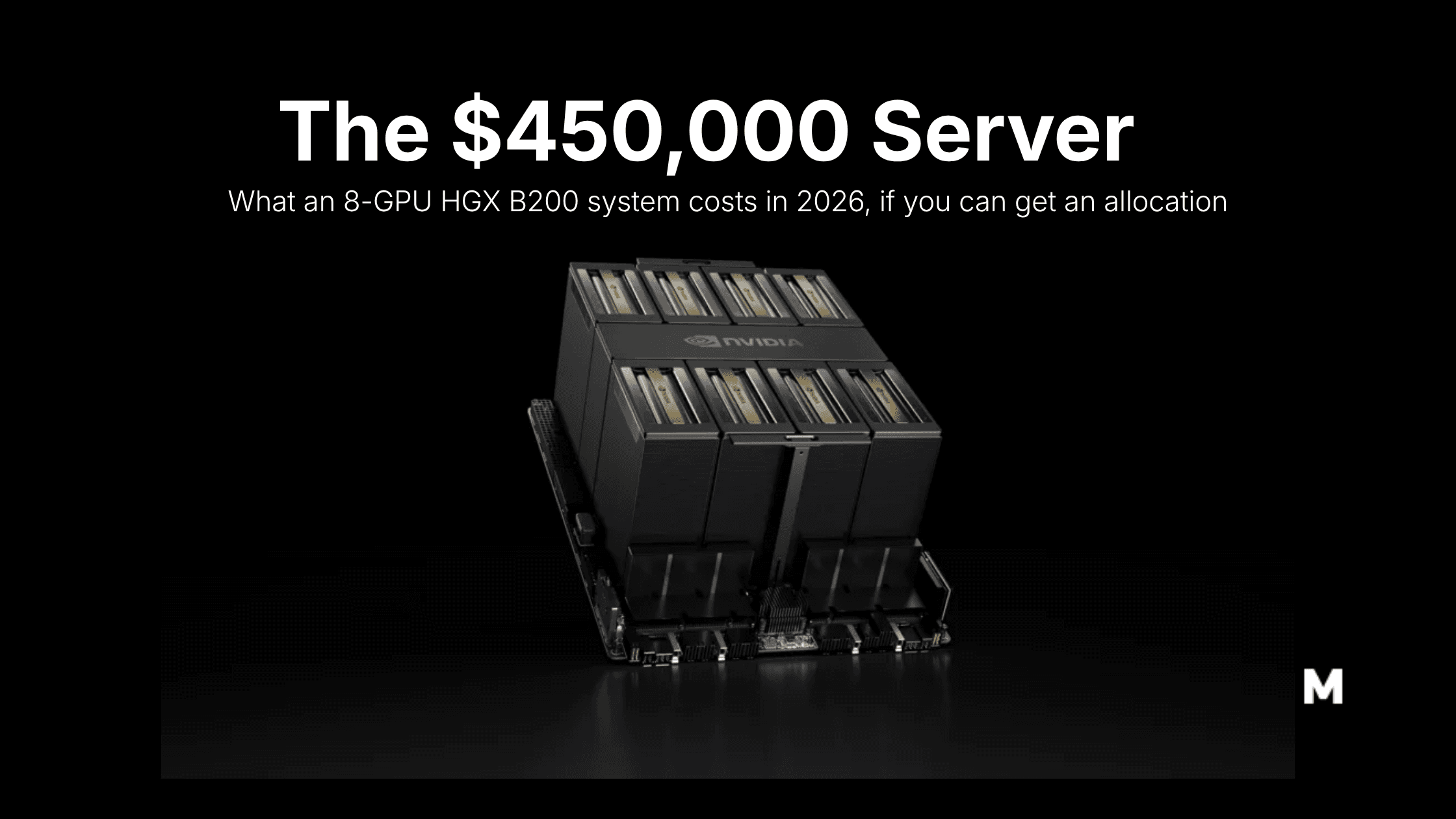
An 8-GPU HGX B200 server costs $400,000 to $500,000 in 2026, with roughly $450,000 as a typical integrated quote, around $56,000 per GPU deployed. That is the number for buyers who can get one. The defining feature of B200 pricing in 2026 is not the price, it is the allocation: most Blackwell production is absorbed by hyperscalers, and institutional buyers face waitlists and enterprise-only channels.
That scarcity shows up in the numbers. B200 cards list at $30,000 to $40,000 in 8-GPU volumes, but street quotes run $45,000 to $50,000. Cloud rates for the same GPU span $3.50 to $27 per hour depending on provider, the widest cross-provider spread of any datacenter GPU we track.
This guide covers the system price, what is inside it, how B200 changes the ownership math, and when H200 remains the better buy. For the sibling analyses, see H200 Server Price and H100 Server Price. For the workload decision framework, see B200 vs H100.
How much does an 8x B200 server cost in 2026?
| Configuration | Price (2026) | Per-GPU equivalent |
|---|---|---|
| 8-GPU HGX B200 server, OEM integrated | $400,000 – $500,000 | $50,000 – $62,500 |
| Typical integrated quote | ~$450,000 | ~$56,000 |
| NVIDIA DGX B200 appliance | ~$515,000 list | ~$64,000 |
| B200 SXM card, list (8+ volume) | $30,000 – $40,000 | |
| B200 SXM card, street quote | $45,000 – $50,000 |
Two things separate this table from the H100 and H200 versions.
First, the gap between list and street price. H100 and H200 quotes cluster in a predictable band. B200 quotes vary with allocation access: buyers with NVIDIA partner relationships see numbers near list, everyone else pays the scarcity premium or waits.
Second, there is no PCIe fallback. NVIDIA dropped PCIe from the Blackwell datacenter line, so the integrated system is not just the sensible acquisition path, it is the only one. The server price is the B200 price.
What's inside the $450,000?
| Component | Approximate cost |
|---|---|
| 8x B200 SXM GPUs | $300,000 – $380,000 |
| Server hardware (CPUs, memory, motherboard, chassis) | $30,000 – $35,000 |
| NVLink fabric / NVSwitch (5th gen) | ~$18,000 |
| Networking and storage | $25,000 – $35,000 |
| Integration, power and cooling engineering, vendor support | $15,000 – $25,000 |
The non-GPU overhead runs $85,000 to $110,000, higher than the $70,000 to $90,000 on Hopper systems. The main driver is power: each B200 draws 1,000W against the H100 and H200's 700W, so an 8-GPU Blackwell system needs beefier power distribution and cooling, and many deployments move to liquid cooling. That cost does not stop at the chassis; it flows into the colocation line below.
8x B200 vs 8x H200 vs 8x H100 server price
| 8x H100 | 8x H200 | 8x B200 | |
|---|---|---|---|
| OEM integrated price (typical) | ~$285,000 | ~$370,000 | ~$450,000 |
| Per-GPU deployed | ~$36,000 | ~$46,000 | ~$56,000 |
| Memory per system | 640 GB HBM3 | 1,128 GB HBM3e | 1,536 GB HBM3e |
| Memory bandwidth per GPU | 3.35 TB/s | 4.8 TB/s | up to 8 TB/s |
| GPU power draw | 700W | 700W | 1,000W |
| Availability | Broad, plus resale market | Broad | Allocated, waitlisted |
The B200 system costs about 22 percent more than H200 and 58 percent more than H100. What it buys is generational: 2 to 3x realized throughput on the right workloads, 192 GB of memory per GPU, and nearly double the memory bandwidth of H200. Whether the premium pays back depends on the throughput rule in B200 vs H100: the price ratio has to be smaller than your workload's realized throughput ratio.
What does an owned B200 server cost per GPU-hour?
Worked example: one 8-GPU HGX B200 server, US Tier-3 colocation, 70 percent utilization, 3-year horizon. Note the conservative resale assumption: unlike H100, there is no functioning B200 secondary market to price an exit against.
// text
Hardware: $450,000 capex
        − $112,500 estimated 3-year resale value (~25% retained, no market to verify against)
        = $337,500 net depreciation
        ÷ (3 years × 8,760 hours × 0.70 utilization)
        = $18.35 / server-hour amortized

Power: 8 × 1,000W GPU TDP × 1.4 PUE × $0.10/kWh ≈ $1.12 / server-hour

Colocation: $150/kW/month × 12 kW ÷ 730 hrs/month ≈ $2.47 / server-hour

Ops + maintenance: ~$0.80 / server-hour

Total effective cost: ~$22.70 / server-hour ≈ $2.84 / GPU-hour all-in
At 90 percent utilization the figure drops to about $2.33 per GPU-hour; at 40 percent it climbs past $4.50. Note the operating lines: power and colocation on a B200 system run roughly $4.40 per server-hour against $3.20 on a Hopper system, because 1,000W GPUs need more billed kW and more cooling. The colocation math behind that line is in Colocation Economics, and the full ownership framework is in GPU ROI.
Buy vs rent: the widest spread we track
Cloud B200 pricing in July 2026, per GPU-hour on-demand:
| Provider tier | $/GPU-hour | $/server-hour (8 GPUs) |
|---|---|---|
| Hyperscalers (AWS, Azure) | $14.13 – $27.04 | $113 – $216 |
| Tier-1 specialty (CoreWeave, Lambda, Nebius) | $6.69 – $8.60 | $54 – $69 |
| Long-tail and marketplace | $3.50 – $5.89 | $28 – $47 |
The spread from cheapest long-tail to hyperscaler on-demand is roughly 7.7x, far wider than the 2.8x we measured on H200. That is what an immature, allocation-constrained market looks like: providers with inventory price to what their segment will pay, and no arbitrage has closed the gap yet.
Against owned economics (~$22.70 per server-hour at 70 percent utilization), owning wins on paper against every rental tier. But the comparison is partly theoretical: the buyer who can get an 8-GPU allocation at $450,000 has access most renters do not. In 2026, B200 acquisition is less a price decision than an access decision, and the deployment capital involved is exactly the territory covered in Financing AI Compute.
The practical read for most teams: if your workload does not clear the B200 throughput threshold, H200 at $370,000 with broad availability, or H100 at $285,000 with a liquid resale market, remains the better capital deployment. See H200 Server Price and H100 Server Price for those numbers.
For current cross-provider pricing, Mercatus GPU Index tracks rates daily.
What moves B200 server pricing from here?
- Supply normalization. Mainstream availability with competitive pricing is expected from 2027. As allocation constraints ease, expect the street-versus-list gap to close and the 7.7x cloud spread to compress the way H100's did.
- B300 ramp. The follow-on Blackwell Ultra parts begin the same displacement cycle that Blackwell started for Hopper. Early B200 buyers should model faster depreciation than H100's observed curve.
- Power economics. At 1,000W per GPU, electricity prices and rack density limits matter more to B200 TCO than to any prior generation. Regions with cheap power gain a structural advantage in Blackwell economics.
Frequently asked questions
How much does an 8x B200 server cost in 2026?
$400,000 to $500,000 for an integrated 8-GPU HGX B200 system, around $450,000 typical, subject to allocation. NVIDIA's DGX B200 appliance lists near $515,000.
How much does a single B200 cost?
List pricing runs $30,000 to $40,000 per GPU in 8-GPU volumes; street quotes run $45,000 to $50,000 under 2026 supply constraints. There is no PCIe variant, so standalone cards are effectively an OEM channel item, not a practical purchase.
Why is B200 pricing so inconsistent?
Allocation. Hyperscalers absorb most Blackwell production, so remaining supply prices to access rather than to a competitive market. The same dynamic produces the 7.7x cloud pricing spread.
Is the B200 server worth it over the 8x H200?
Only if your workload's realized throughput gain exceeds the roughly 22 percent system price premium plus the higher operating cost. Frontier training, very large model inference, and power-constrained sites usually clear the bar. Most other workloads do not yet. See B200 vs H100.
What does an owned B200 server cost to run?
Roughly $22.70 per server-hour all-in at 70 percent utilization on a 3-year horizon, about $2.84 per GPU-hour, with a conservative resale assumption since no B200 secondary market exists yet.
How much power does an 8x B200 server need?
GPU load alone is 8 kW (8 x 1,000W), against 5.6 kW for Hopper systems. Budget 12 kW or more of billed colocation capacity, and expect liquid cooling requirements at density.
Should I wait for B200 prices to drop?
If your workload does not clear the throughput threshold today, yes. Mainstream availability is expected from 2027, and the current scarcity premium should compress with supply. Teams that need capacity now are better served by H200 or H100 at proven pricing.
Methodology
System and card pricing reflects public OEM and marketplace quotes and published market trackers as of July 2026. Cloud pricing tiers compiled from published provider rate cards, July 2026. Ownership model uses the same amortization method as the Mercatus H100 and H200 server analyses. B200 resale assumptions are conservative estimates; no functioning secondary market exists to verify against. Last verified: 2026-07-16.